

Now you know the chords that work well together in the key of let’s look at various some chord progressions used in songs of varying genres. You can use any key.
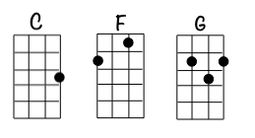
If you have completed the UKULELE BLUES FOR BEGINNERS course, you will know that most Blues music uses the 1 – 4 – 5 chord progression, which in the key of C major would give you the chords, C, F & G. This same progression was essential in the development of Rock ‘n’ Roll, country, Reggae, Rock and Pop.
Click on the song titles below to hear each of the songs. This is a great way to study song form. Listen out for the tempo and try and get a feel for the rhythm.
If you have completed the UKULELE BLUES FOR BEGINNERS course, you will know that most Blues music uses the 1 – 4 – 5 chord progression, which in the key of C major would give you the chords, C, F & G. This same progression was essential in the development of Rock ‘n’ Roll, country, Reggae, Rock and Pop.
Click on the song titles below to hear each of the songs. This is a great way to study song form. Listen out for the tempo and try and get a feel for the rhythm.
|
LA BAMBA – Los Lobos (Key: C) WILD THING – The Troggs (Key: A) TWIST & SHOUT – The Beatles (Key: C#) STIR IT UP – Bob Marley & The Wailers (Key: A) FOLSOM PRISON BLUES – Johnny Cash (Key: F) |
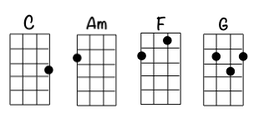
et’s look at chord progression of 1 – 6 – 4 – 5, made popular in the 1950s with the likes of Earth Angel, Blue Moon, Donna and All I Have To Do Is Dream. This progression is known as DOO-WOP or the Heart & Soul chords and has since crossed many decades and genres.
|
(50s) ALL I HAVE TO DO IS DREAM – Everly Brothers (Key: E)
(60s) STAND BY ME – Ben E King (Key: A) (70s) I WILL ALWAYS LOVE YOU – Dolly Parton (Key: A) (80s) ENOLA GAY – OMD (Key: F) (2010) JUST THE WAY YOU ARE – Jason Mraz (Key: F) |
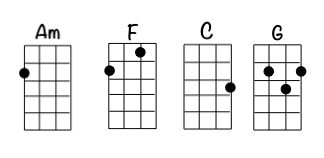
Now let’s start with a minor chord with this progression that has been more popular since the year 2000 onwards: 2 – 4 – 1 – 5
|
SAVE TONIGHT – Eagle-Eye Cherry (Key: Am) IF I WERE A BOY – Beyonce (Key: D#m) ZOMBIE – The Cranberries (Key: Em) KIDS – MGMT (Key: F#m) LOVE THE WAY YOU LIE – Rhianna & Eminem (Key: Gm) |
So, there you have some basic chord progressions and examples, but note that not all songs start with the root note chord their main key, they can also start on other chords, but will usually resolve to the root chord during the chorus or hook. Some songs will also combine progressions, contain extra chords and variations and possibly a key change or two.
Watch the video to see the chord progressions above fit in with some of the songs in the key of C. As you will realise, all of the songs are created at different tempos and have varying rhythmical structures.
Now you know the basic formulas for constructing chord progressions out of a major scale, you can go break all these rules to make the magic happen, just like the Beatles did in so many of their songs.
For song writing exercises, it can be useful to have a go at using the chord progressions above, trying alternative rhythms and seeing if you can hum a brand-new melody over the top. But for originality, try different chord sequences altogether. In the next module you will explore key changes so that you can work out the chords for each of the songs above.
For song writing exercises, it can be useful to have a go at using the chord progressions above, trying alternative rhythms and seeing if you can hum a brand-new melody over the top. But for originality, try different chord sequences altogether. In the next module you will explore key changes so that you can work out the chords for each of the songs above.